
What Happened in the 1Password Data Breach?
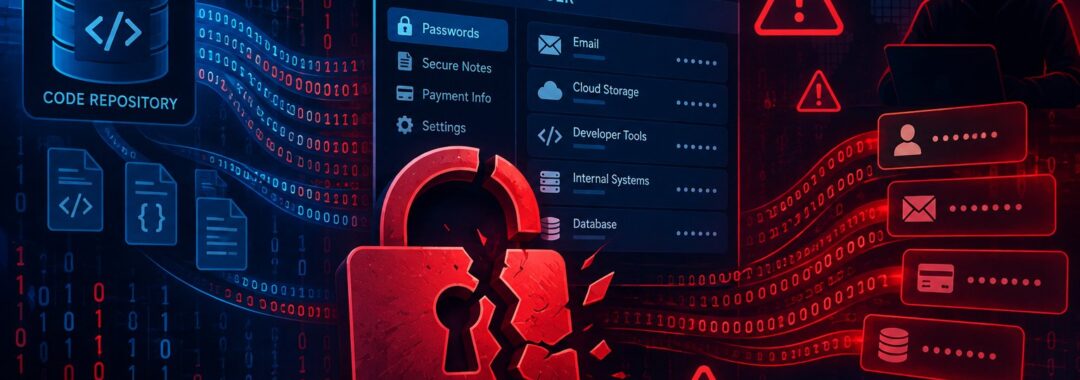
A significant 1Password data breach has been disclosed, with the popular password management company confirming that an attacker gained unauthorised access to customer information through a compromised GitHub account. According to the report, the Toronto-based firm discovered the incident on November 19, 2026, when suspicious activity was detected on an employee’s corporate GitHub account.
The company emphasised that whilst customer names and email addresses were accessed, no password vaults or secrets were compromised. This distinction is critical for the millions of users who rely on 1Password to secure their most sensitive credentials.
“While we took immediate steps to contain the incident, the attacker gained access to some of our backend systems and accessed a limited amount of customer account information from a subset of our customers, including names and email addresses.”
Source: The Hacker News
Technical Analysis: How Did the Attack Unfold?
The threat actor weaponised a compromised employee GitHub account to access source code and push malicious code to 1Password’s backend services. This supply chain-style attack resulted in the download of administrative customer data.
Data Accessed During the Breach
According to 1Password’s disclosure, the following customer information was accessed:
- Names and email addresses
- Account and user identifiers (including account creation and last sign-in times)
- Public keys
- Secure Remote Password protocol parameters
- Tokens present in certain emailed links for invitations, provisioning, and account recovery
- Non-secret internal metadata about accounts
Source Code and CI/CD Access
The attacker also copied source code from private repositories and gained access to 1Password’s CI/CD system. However, the company stated that source code “is not customer data, and contains no user secrets,” adding there is no impact to service availability or product security.
Critically, 1Password confirmed that vault secrets remain protected: “Your vault secrets are encrypted with keys that only you hold, so we can’t access them, and neither can an attacker who gets into our servers.”
What Immediate Actions Has 1Password Taken?
The company has implemented several remediation measures following the 1Password data breach:
- Disabled the affected GitHub account
- Revoked the stolen token
- Hardened GitHub, CI/CD, and endpoint controls
- Restored clean versions of affected services
- Rotated internal credentials
- Lengthened invitation and recovery email codes from six digits to ten characters
1Password noted that the tokens embedded in emailed links cannot be used alone to access customer accounts, as doing so requires either single sign-on (SSO) authentication or a verification code sent to the user’s registered email. A small number of affected users have been individually notified.
Business Impact of the 1Password Breach
Whilst password vaults remained secure, the exposure of customer email addresses and account metadata creates significant phishing risks. Attackers armed with this information could craft highly convincing social engineering campaigns targeting 1Password users.
The breach also highlights the ongoing risks associated with developer toolchain security and the potential consequences when source code repositories are compromised. Organisations using password managers as part of their security infrastructure should take note of these supply chain risks.
What This Means for Australian Organisations
Note: The source material does not indicate whether Australian users were specifically affected. The following is general guidance for Australian businesses.
- Australian organisations using 1Password should monitor for phishing attempts targeting employees, particularly those referencing password management or account security
- Under the Notifiable Data Breaches scheme, Australian entities should understand their obligations if third-party services they rely upon experience data breaches
- The ACSC Essential Eight recommends multi-factor authentication and application control—controls that remain relevant when evaluating password management solutions
- Consider conducting a cyber security maturity assessment to evaluate your organisation’s third-party risk exposure
Actionable Recommendations
Based on this incident, organisations should consider the following best practices:
- Enable multi-factor authentication on all password manager accounts and critical services
- Train staff to recognise phishing attempts, especially those referencing security tools they use
- Review GitHub and CI/CD security controls, including token management and access permissions
- Implement secrets management solutions to reduce exposure from compromised developer accounts
- Monitor for credential stuffing attempts using potentially exposed email addresses
For assistance reviewing your organisation’s password management security posture and third-party risks, speak with our security team.
Frequently Asked Questions
Were 1Password vaults compromised in this breach?
No. According to 1Password, no customer vault content, passwords, secrets, or account recovery keys were accessed. The company stated that vault secrets are encrypted with keys only the user holds.
What should 1Password users do now?
1Password has stated that customers do not need to take any action but should remain vigilant against unexpected phishing attempts. Users whose accounts were directly affected have been individually notified.
How can organisations protect against supply chain attacks?
Organisations should implement strong access controls on developer tools, enable MFA on all GitHub and CI/CD accounts, regularly audit repository access, and consider managed security services for ongoing monitoring and threat detection.
Key Takeaways
- The 1Password data breach exposed customer names, email addresses, and account metadata—but not password vaults
- The attack originated through a compromised employee GitHub account
- Source code and CI/CD systems were accessed, though 1Password states this poses no product security risk
- Affected users face increased phishing risk and should remain vigilant
- The incident highlights the importance of securing developer toolchains and supply chain security
Conclusion
The 1Password data breach serves as a reminder that even security-focused companies face sophisticated threats targeting their development infrastructure. Whilst the core security promise—that password vaults remain encrypted and inaccessible—appears to have held, the exposure of customer metadata creates real risks that organisations must address through heightened phishing awareness and robust security controls.